Friday, November 12, 2010

Thought I'd Never Get Around to Posting

In my Intro to Phil class several weeks ago we had a long discussion about rationality, about consistency of belief, and about consistency between belief, intention, and action. It coincided with the day of a campus lecture by Dan Ariely.

A student sent me this link to an article by David McRaney about procrastination and self-control. It took me weeks to get around to reading it. And now that I have, I thought: should I post it now or later?! (So you can see why I've posted so little over the last months. If this one weren't itself on procrastination, chances are slim I would have written it up.)

The article notes that for those of us with Netflix queues, most lists are very long, and the documentaries and historical dramas tend to build up without getting watched--moreso for those that are available Instantly than those ordered through the mail. Of course, that's because we all want to be good people who watch heavy, enlightening, worthwhile films. But that's in our future, and in our present we're just too tired to watch anything more challenging than Close Encounters of the Third Kind.

[Personal note: I have my own rules about this sort of thing! My queue is short, and the order is more or less strict. Earlier this week I watched a docudrama about conservation in Africa and tonight's show will be a critically-acclaimed war movie. Oh, but that's the point about handling procrastination...]

McRaney writes:
Capable psychonauts who think about thinking, about states of mind, about set and setting, can get things done not because they have more will power, more drive, but because they know productivity is a game of cat and mouse versus a childish primal human predilection for pleasure and novelty which can never be excised from the soul. Your effort is better spent outsmarting yourself than making empty promises through plugging dates into a calendar or setting deadlines for push ups.
The trick to dealing with procrastination, then, is to anticipate when it may strike and to limit in advance your ability to make choices in the present which you would not have set up for your future self. That is, to develop good habits--by hook or by crook.

Here's Roz Chast's take on procrastination.

Wednesday, November 10, 2010

What Am I Worth?

Salary reports for jobs like yours can be found at Payscale.com.

Curious about the answer without looking it up?

Here's what I came up with:

Assistant Professor of Philosophy: average = $57,500; starting salary = $43,700
(This ignores the fact that you really probably started with a stipend for TA'ing and took a lateral move to $3000/course as an adjunct before spending at least a couple of years in a postdoc or visiting position.)

Associate Professor of Philosophy: average = just shy of $60,000; starting salary of $42,000
(Hmmm...that assistant professor starting salary of 43K looks good in comparison. Doesn't much look like tenure is promising immediate fiscal benefits, does it?)

Full Professor of Philosophy: average = $105,500
(The range is from $71,000 to $152,500. Start totting up those merit increases early in a career because percentages will eventually accumulate. Your university still gives raises in these tight times, right?)

Assistant Professor of Economics: average - $73,616; range of $52K to $124K
(Ah...but those poor souls don't get to spend their days talking about trolleys rolling over babies, barn facsimiles, and brains in vats. What is a lifetime of that worth to you?)

Berkeley Begat Heisenberg Begat Wigner

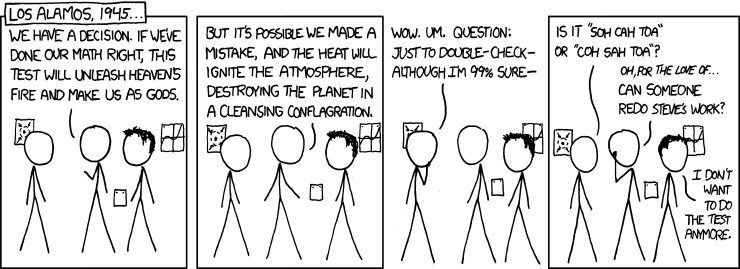
Check out today's XKCD comic.

Need this?

Tuesday, November 02, 2010

The Face of Philosophy

Ordinary life and ordinary academic life have left me this term with little time to dabble or to play. I've been spending my time preparing for class and engaging in the rough politics of transitioning from quarters to semesters. The blogs have been busy, but I haven't been visiting them.

That's why I felt like I had found a lucky penny when I happened across this photo essay on philosophers. I found it a few days late but the sentiments are timeless. It's satisfying to see a representative percentage of women among the photos, as well as portraits of feminist philosophers with the accompanying essay.

My wish is that there will come a time when I won't even notice women philosophers being treated like this--treated equitably and simply as philosophers, with no need to comment on gender.

Friday, October 22, 2010

Check Your Calculations

Can't wait to show this xkcd comic in a philosophy of science course when we talk about inductive risk. Click through and hover over the last panel for more...

Monday, October 18, 2010

Race to the Bottom

My institution is about to convert from a quarter to a semester calendar system. Everything about the curriculum is already up for grabs, and so we're also completely remodeling the requirements for general education. The university-wide committee has submitted a proposal that would make it at least possible, and maybe even easy, for a student to complete a college degree without ever taking a course in the humanities or social sciences.

One other time I taught in a university in which there were suddenly fewer students taking humanities courses than previously, resulting in stiff competition for students. There are two ways to win that competition--by attracting students through word-of-mouth (e.g. by assigning all A's) and by attracting them with catchy course titles.

I have a title for an Intro course (a topical survey) all ready to go:
Philosophy from A to Z: The Unborn to the Undead.

Tuesday, October 05, 2010

Hooray, I'm not alone

Announcing a blog about What It's Like to Be a Woman in Philosophy.

The blog accepts submissions from you: from any philosopher, teacher or student.

The blog has multiple goals. First, and most obviously, it is comforting to know that you (women with negative experiences) are not alone and that the causes of women-specific experiences are systemic.

Secondly, the blog is not only about negative experiences. It can also be used to highlight how things have changed for the better over time, to share ideas for dealing with unexpected and unhappy encounters, and to create recognition for how small or minor negative experiences accumulate.

Thursday, September 30, 2010

Michael Eldridge

Pragmatist philosopher Michael Eldridge died unexpectedly on Sept. 18, sad news indeed.

Talking with Mike has always been a highlight of my attendance at SAAP. Always ready with something interesting to talk about, Mike was one of those philosophers, not as common as you might think, who led his life and interacted with people in a way that was of a piece with his philosophical convictions.

His personal support and his welcoming attitude at SAAP meetings were instrumental in turning me toward pragmatism. In his company, it was obvious that a philosophical attitude which is meliorist--optimistic about human progress--but pragmatic--grounded in factually assessing how to make a difference--is not only well-justified but also a fine way to lead a life.

Tuesday, September 28, 2010

Gender and Skepticism

A colleague told me a disheartening observation/hypothesis concerning the students in his epistemology class.

The class as a whole has generally had a positive reaction to the readings assigned thus far in the course but had a negative, even hostile, reaction toward the latest article they discussed, a marvelous piece by Miranda Fricker called "Scepticism and the Genealogy of Knowledge."

My colleague is a contextualist, a feminist, and a pragmatist anti-skeptic. "I just realized how, if I wanted to, I could once and for all turn the class opinion against the skeptic," he confided. "All I'd have to do is to consistently refer to the skeptic as 'she'."

Thursday, September 02, 2010

Baby Logic and a Question

I've been talking with philosophers in my department about curriculum revisions and our logic course. Right now we only have one logic course. It would be nice to add an advanced course, but I don't particularly want to teach it--or rather, I'd like to teach it, but there are about a dozen courses I'd like to teach more than that one.

Some of us have referred to the course as "baby logic." This is a term I heard a lot in grad school, where there was a 1-quarter baby logic course and 2 further quarters of advanced topics--and none of those even touched on modal logic or many other possible topics in philosophical logic.

My question for you is why it's called baby logic and what baby logic refers to. Is it the content of a standard introductory course (even when "introductory" means "all you can ever get at this institution without taking your pretty self over to the math department")? That is, is baby logic sentential and predicate logic up to (or through) identity? Or is it less? One colleague thinks "baby logic" refers only to the informal logic that is typically taught in critical thinking courses. I could see how it might refer to sentential logic--on the grounds that truth trees are a mindless automatic procedure but models in predicate logic are not.

Tuesday, August 17, 2010

CFP: Metaphysics and the Philosophy of Science

METAPHYSICS & THE PHILOSOPHY OF SCIENCE CONFERENCE

Presented by the Institute for the History and Philosophy of Science and Technology, University of Toronto
and the Fishbein Center for the History of Science and Medicine, University of Chicago

13-15 May 2011
University of Toronto

The philosophy of science has an illustrious history of attraction and antipathy towards metaphysics. The latter was famously exemplified in the Logical Positivist contention that metaphysical questions are meaningless, but in the wake of the demise of Positivism, metaphysics has found its way back into the philosophy of science. Increasingly, questions about the nature of natural laws, kinds, dispositions, and so on have taken a metaphysical cast. The metaphysics of science commands significant attention in contemporary philosophy.

While many philosophers embrace the increased contact between metaphysics and the philosophy of science, others are wary. Should science (and its philosophical study) lead us into doing metaphysics? If so, which metaphysical issues are genuine and which are illusory, and how might we tell? Such questions dovetail with similar soul-searching in metaphysics proper (sometimes under the banner of "meta-metaphysics", sometimes simply as methodology).

This conference will examine ground-level debates about metaphysics within the philosophy of physics and the philosophy of biology as well as broader methodological questions about the role of metaphysics in the philosophy of science. Participation is open and welcome from all parties to these questions: from those who hold that metaphysics must have a place within the philosophy of science, to those who hold it should not.

PLENARY SPEAKERS
Craig Callender (University of California, San Diego)
Anjan Chakravartty (University of Toronto)
Katherine Hawley (University of St. Andrews)
Jenann Ismael (University of Arizona)
James Ladyman (University of Bristol)
Kyle Stanford (University of California, Irvine)
Michael Strevens (New York University)
Robert Wilson (University of Alberta)
C. Kenneth Waters (Minnesota)

SUBMISSIONS

Essays of 4,000-5,000 words (30 minutes allotted for presentations) concerning any aspect of metaphysics and the natural or social sciences will be accepted for review until January 10, 2011. Please include a short abstract (200 words or so), a few keywords, prepare your essayfor blind review (do not include your name or other identifying references in the document), and submit it in PDF format here.

Science and Policy: Deforestation

Regular readers of this blog know that I do this more for myself than for you. Is there any handier, searchable, linkable way to keep track of the things I come across which might someday make useful handouts, references or exercises to use in my teaching?

Using the blog in this way is an idea I got from Rob Loftis, whose blog also files away his teaching ideas and notes from the AAPT conferences. I think I'll modify this one to use in my Intro to Philosophy class this fall, and I've thought about--but never actually stolen--his exercises on Twelve Angry Men.

****

Last time I taught Environmental Philosophy, we spent a week talking about deforestation at the end of the course. It's a messy environmental/economic issue that offered an opportunity to review and integrate a number of the theoretical topics from earlier in the course. To provide background, I assigned this New Yorker article about illegal logging. Now, a news story that gives a swift update.

In essence, illegal logging may have decreased in the past decade (by 22% globally). That would be good news. But, then again, if no one has any idea how much timber is passing from the tropics and Siberia into China, then how can this report be accurate?

Science and Policy: Climate

Sometimes when teaching about the ethics of climate change, I hope to find a really short but authoritative newspaper article to give students. I like them to see some figures about the magnitude of climate change and to get an idea about the effects of global warming in terms that are easy to understand.

Here is a one-page news article from the AAAS, describing the contents of the latest NRC report.

The closest the committee comes to a policy recommendation is to point out the magnitude of the challenge. "Emissions reductions larger than about 80%, relative to whatever peak global emissions rate may be reached, are required to approximately stabilize carbon dioxide concentrations," it observes.

The paragraph sounds critical. Is such restraint from recommending specific policy choices required by objectivity, professional respect for policy-makers, common sense, or good taste?

On the one hand, a report focused on science should not make recommendations that can't be justified within the space given. So a recommendation for a cap-and-trade policy, or a rejection of a tax on emissions, or an expressed preference for investing more heavily in the development of tidal power, would certainly be beyond the scope of the report. On the other hand, reports, like journal articles, are rhetorical devices and are structured so that it is clear which parts are descriptive and which prescriptive. Other NRC reports have not shied away from offering prescriptions for change in education, in medical practice, and in other policy areas. There is no good reason the NRC couldn't maintain neutrality with regard to specific alternative energy development policies and conservation policies without offering much stronger verbal support that more needs to be done. Much, much more.

Thursday, August 12, 2010

David Hull

I'll remember David Hull for the support he showed to young philosophers and for the fierce and unwavering loyalty he had for his friends, who were many. Talking to David allowed one to make a molehill out of any mountain. Problems could be figured out, deconstructed, detoured around, or walked right over. The size of a problem did not discourage him from taking it on, even when doing so required 600 pages or decades of activism.

John Wilkins, at Evolving Thoughts, has posted a memorial note and a description of David's philosophical work and its impact.

Wednesday, August 11, 2010

Scientific Communities and Equality of Authority

Philosophers theorize, and too often we're undisturbed by the tremendous gap that can appear between the ideal theories we develop and the practices that could actualize those theories.

In her study of the ideal structure and function of scientific communities, Helen Longino argued in favor of applying the Habermasian ideal democratic speech conditions to scientific communities. Thus, well-structured scientific communities would (should) be structured so that members:
a. are willing to genuinely engage with each other;
b. treat each other as moral, political, social, and intellectual equals; and
c. are willing to modify their beliefs in response to criticism and evidence.

Item c is actually not so hard. Peer review of published work and peer pressure in general exert some force. But how in the world can item b be accomplished?

Though many philosophers of science have written on and built on Longino's work, not much has been done to identify how to nudge real scientific (or our own academic) communities in directions that would meet these ideal conditions.

Atul Gawande suggests that one thing that can improve the communicative equality of communities of professionals working together is to use checklists. Huh? So simple? The bridge between theory and practice is constructed of little practical steps.

From Michael Goldman's review of Gawande's The Checklist Manifesto:
The safe surgery checklist that Gawande helped develop instructs the entire [surgery] team to introduce themselves by name and role and to discuss the unusual aspects of the case and potential problems. The checklist distributes power, so that a nurse reading a checklist acquires the authority, as a member of of the team, to stop the surgeon from omitting a critical step or making a stupid mistake.

Scientific communities do not usually work under the constraints and risk of crisis that surgery teams do, but the larger point is that formalizing working methods and instituting time for face-to-face communication between team members can change the social and power dynamic of collaborative teams.