Showing posts with label teaching. Show all posts

Tuesday, April 17, 2012

Education as Consumption


The business model of higher education which conceives of education as being a consumer good like any other has been criticized on many grounds: it trivializes education overall, it reduces emphasis on humanities and sciences, it drives up grades and drives down rigor, and it inflates tuition costs.

Blind to these criticisms--and to subtlety--my university just introduced a course registration system which asks students to put the courses that they would like to take into their "enrollment shopping cart."

Monday, February 27, 2012

Philosophy's Blind Spot

I just received a promo textbook for teaching Intro to Phil. It contains 34 excerpts from primary texts. Five of those cover Hinduism and Buddhism. One of them is by a woman--a literary theorist writing about feminist aesthetics. Well, the world's population includes a whole lot of Hindus and Buddhists.

Friday, June 24, 2011

Innovations in Ethics Curricula

Innovations?! Well, no. Here is yet another of my frequent complaints! Textbooks in ethics (and in Intro to Philosophy, and in Philosophy of Science, and in Environmental Philosophy, and I'm sure in most of our other areas) go through frequent editions but each edition contains the same old topics with the same old papers.

Yes, some of the old papers are classics and nothing else compares. Judith Jarvis Thomson on abortion. But in general, except for the addition of pieces on climate change, an ethics anthology now looks almost exactly like an ethics anthology when I was in college--over two decades ago! And some of the pieces seemed dated to me then.

Today's exemplar just arrived in my mailbox--Social Ethics: Morality and Social Policy, edited by Mappes, Zembaty, and DeGrazia and in its 8th edition with McGraw Hill. I don't think this text is any worse than all the others, but it's not better, either.

Take the example of the chapter on climate change. It contains 10 selections, but only 2 of them were written in the last decade! Both of those pieces are written by philosophers but were originally published in the popular press.

And let's look at the gender breakdown--something that should be informative about the degree of currency and creativity in an anthology. Women constitute 20% or so of professional philosophers but a much higher percentage among ethicists. In addition, this text has sections s on issues that have been extensively examined from a feminist perspective: sexual ethics, abortion, marriage, pornography, and global and economic justice. Finally, the text includes selections written by practitioners (rather than exclusively by philosophers) and published in the popular press (rather than just in philosopher journals).

So what can possibly explain this breakdown?
Of the pieces with named authors, only 15% have a female author. Some of those female authors have more than one piece in the anthology, so that only 12% of authors are female!

The cost of the text is over $100. Do any of these pieces come with an expiration date? I drink fresh milk, eat fresh eggs, and insist on fresh fruit. My mind requires fresh nourishment as well.

Wednesday, February 16, 2011

One Color and One Sex in Philosophy


I just got an announcement in my inbox for a new Intro to Philosophy text. This one is written in a way that makes liberal use of contemporary films so that students
"will not only discover a new relevance to their own lives, but will dissect the key readings with a perspective they were previously unaware of."
One wonders if the book is supposed to be relevant to women students, too. Out of 42 authors, the majority of them 20th- and 21st-century authors, only 2 are women. That's less than 5%! Not only is that far lower than the percentage of Intro to Philosophy students who are women, it's lower even than the still-very-low estimate of women teaching philosophy.

The text is called "Introduction to Philosophy in Black, White, and Color" but--ahem--the only color I see is White.

Friday, February 11, 2011

Books with nice covers and nice pages

Don't judge a book by its cover?

Why not?

The Modern Library hardbacks on my shelf have such lovely brass-colored dust jackets with black-and-white images, nice firm cloth bindings, and smooth, impossibly thin pages which never seem to yellow. Are they still being published? I just floated around the Random House site, here, and only found paperbacks. Even brand new, the hardcovers had prices only a hair above the competitors' paperbacks. I loved them!

I'm teaching Modern Philosophy in the spring, for the first time in over 10 years. And imagine my shock: E.A. Burtt, The English Philosophers from Bacon to Mill is entirely out of print! Strangely, its companion volume, Monroe Beardsley, The European Philosophers from Descartes to Nietzsche, is not. But that one is available only in paperback.

What's a good solution? What are other folks doing? I ordered The Empiricists instead. But I hate having a mismatched set. And are Locke and Hume not worth reprinting when Spinoza et alia are?


Thursday, February 10, 2011

At C

I'm approaching the end of a term. Just one more week, and I have many students in my upper-level classes who have not turned in work. Major assignments, minor assignments. Some are brilliant when they participate in discussion, but it seems they can't get around to the written comments which make up 35% of the grade. When the students in question are math majors, engineering majors, physics majors...failing to understand numerically how that will affect their grade is not possible.

One of the classes I'm teaching now I haven't taught since 2005. Some reading materials which students found a reasonable challenge 6 years ago now completely stump a significant portion of the class. They don't even attempt the reading. Not to mention that more than one can't read cursive, so how are they getting the notes I write on the board?

Have standards at my university changed in only 6 years?
Is there something unusual about how or why students enrolled in this particular class?
Is there a larger pattern?

The book Academically Adrift: Limited Learning on College Campuses by Richard Arum and Josipa Roska has been getting some attention and does point to a larger, even national, pattern.

From an interview with Salon:
Fifty percent of the kids in a typical semester say they haven't taken a single course where they've been asked to write 20 pages over the course of the semester. And 32 percent have not taken a single class the prior semester for which they've been asked to read more than 40 pages per week on average, and in terms of homework, 35 percent of them say they do five or fewer hours per week studying alone.
OK, guilty as charged. In one class I'm requiring students to write over 20 pages but most are coming in far below the expectations I expressed--both in terms of quality and quantity. In the other class, I'm only requiring about 15 pages of writing. Both classes have over 30 students. I think I spend too much time on grading. My students tell me I require more writing than many of my colleagues--particularly those in other liberal arts disciplines. I believe them. Because if they were practicing writing regularly they'd be better at it than they are.

So here's the bind. My colleagues are requiring less work. My students are expecting to do less work. I want to set them tasks which are challenging but possible. And the bar for what is possible falls a little every year. We are stuck in a pattern of decline, and it seems to be a problem of collective action. No one is positioned to make a change without paying a cost.

More from the Salon interview:
There's a longstanding tradition of some students going through college with little asked of them and little learned. Nothing is new about that. However, there is significant evidence out there that something has changed in terms of the academic rigor and student workload.... Full-time college students spend 50 percent less time studying than they did several decades ago. We also know that in terms of grades, students expect to receive higher grades and do receive higher grades in spite of less effort.
Philosophers are surely as much a part of this drift as other disciplines. The book reports that 45% of the students followed in the study (at a wide variety of campuses) failed to progress in developing critical thinking and analytical reasoning skills in their first two years. That's our department, no? Not just us, but we surely play a central role.

It's possible that one of the things to blame is something I love dearly: academic freedom. No one tells me what or how to teach, and I take the responsibility to teach well seriously. But with no one looking, it is all too easy for some of us to slide a lot and all of us to slide a little.

Tuesday, January 25, 2011

Argument from Partial Understanding

The argument from ignorance is a fallacy which runs like this:
  1. We have not proven beyond all doubt that X is true.
  2. Therefore, X is probably not true.
Its close cousin is the argument from incredulity:
  1. I would hardly be able to believe it if X were true.
  2. Therefore X is not true.
It also takes this form, which I call the egoistic form of the argument from ignorance:
  1. If X were true, then I would know it were true (or I would understand claim X).
  2. I don't know for a fact that X is true (or I don't understand claim X).
  3. Therefore X is not true.
I just saw a version of this argument applied to the question of scientific realism, call it an anti-realist argument from the position of egoistic partial understanding:
  1. Realists believe in the literal truth of scientific statements about both observable and non-observable (or theoretical) entities, while anti-realists grant this level of belief only for statements about observable entities.
  2. Bridges are observable, concrete is observable, and cracks in concrete are observable; molecules and molecular bonds are not so observable.
  3. I'm an engineer, and I understand bridges, concrete, and stress fractures; I never really understood what was going on in my organic chemistry class.
  4. Therefore engineers like me should be anti-realists.
What the student in question thought was really mind-blowing about this argument was that until he came up with it, he thought he was a realist. But then he realized that was only a case of naive realism, and that engineers like himself can treat most scientific claims as if they're true, whether or not they're really true, and that this is good enough for their purposes.

The real absurdity is that bad reasoning or not, there's validity to this explanation of what engineers' belief in science requires!

Thursday, January 20, 2011

Johnny Can't Write

When I complain that my students can't write, what I usually mean is that they can't form coherent arguments, or that their writing style is pedestrian, or even that the sentences are ungrammatical. But today I have something more shocking to report.

I've had a student ask if I could develop an alternative test-taking arrangement for him, not because he has a formal academic accommodation (he doesn't), but because he never learned handwriting skills. He can't write in cursive. And after seeing a sample of some notes he took, I believe that he can't print either. Some letters were small case and some were capitals, with no rhyme or reason. I would not be able to read an essay test written in this handwriting.

The student's explanation was that he went to a Montessori school through 6th grade, and that this school just didn't teach handwriting. He said he had a really hard time in 7th grade, and tried to learn to (hand)write, but by then most of the students' work was in typed form anyway. When I started looking around for more information, I found that the problem is not isolated and doesn't seem to be just in Montessori schools. It's widespread. From a Cincinnati newspaper:

Cursive writing is "not addressed as a skill anywhere in Kentucky's core content, and there are so many other things that are," said Terry Price, director of elementary education for Bullitt County Public Schools. "Students need to be able to sign their name and be able to read it, but I think we'll get to a point in the future where it's not necessary at all."

For now, however, most educators are still teaching cursive writing, said Vanderbilt University professor Steve Graham, who conducted a study on the subject in 2008. He and other researchers surveyed about 170 first-, second- and third-grade teachers across the nation and found that 90 percent taught handwriting.

The time spent on those lessons averaged about 60 minutes a week, but some spend as little as 10 minutes a week on it, and the majority of teachers said they didn't have any real training in how to teach penmanship, Graham said.

Others call cursive writing skills "quaint" and tell stories of 7th graders unable even to read cursive handwriting! I'm shocked to learn that 10% of primary school teachers are not teaching handwriting, and that some spend only 10 minutes a week on it.

I made some calls around campus to see about whether this student could write his exam with a keyboard and one of the people I talked to proctors SATs at our testing center. SATs are now entirely electronic, except there is a one-sentence statement that students must copy, swearing to their identity and honesty. She says that handwritten statement is the hardest part of the exam for some students, that it can take them up to 20 minutes to copy, and that they absolutely cannot write it in cursive.

Do (or should) teachers deduct points for bad handwriting? I tell my students that if I can't read their ideas, I can't give credit for them.

Monday, January 17, 2011

Paradigm Shiftyness


Yay, today my philosophy of science course discussed paradigm shifts. So fun.

After class a student asked me whether the news of the discovery of a 13th zodiac sign counts as a paradigm shift.

Me: Huh? A 13th zodiac sign?

Student: Oh yes, it was the Babylonians who discovered the zodiac, but the north star has shifted since Babylonian times. So now the line that is where the zodiac is includes an additional constellation that people didn't realize was actually in the zodiac line before this.

Me: Huh? Do you mean declination? You know the axis of rotation of the earth wobbles...

Student: Oh yes, that's it, and this is so freaking me out. And my mom is freaked out, too, because she says she's been a Cancer her whole life but she was mistaken and didn't even know it!

Me: And you think this is a scientific paradigm shift?

Student: It has to be! And we're living through it! It changes our whole outlook, you know? On life and stuff?

Me: And it's scientific?

Student: Totally. And I just don't know what to think about my sign and my personality now. I mean, who am I really?

Me: So what sort of scientist made this discovery? A historian? An archaeologist?

Student: This is totally huge. It was all over facebook.

Me: Huh?

I'm trying to figure out if I flubbed this one. Was there any better response than saying "Huh?" over and over. I tend to think not.

I found this on the ABC news website:
An astrological controversy erupted online Thursday after a newspaper article erroneously suggested that the dates that determine the Zodiac signs had shifted by about a month, throwing millions of believers into self-doubt and panic.
"Erroneously?" How can a NEWS site make a claim one way or the other about an astrological claim being right OR wrong? Hello? There is no truth value to claims that have no referent?

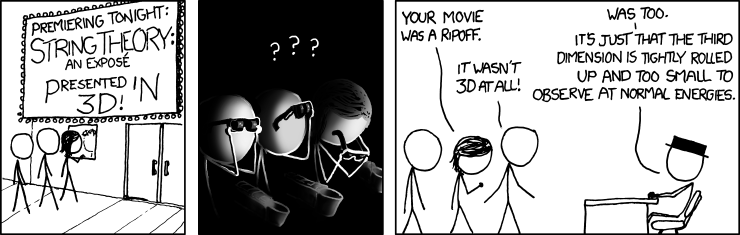
And I just don't know what to say about this being "all over" facebook. My facebook newsfeed includes these items: Quebecois winter humor, a recipe for tortilla soup with plenty of friendly commentary on tasty variations, pictures of kids, pictures of ski tracks in the snow, pictures of kids in the snow, a feminist rant (Dear Pandora, I don't appreciate the Match.com ad, followed by the Plan B Pill ad, followed by an ad with a giant cupcake...I don't like what your trying to say. Go screw yourself Pandora), a recommendation for independent theater, lots of fine art photography, and more than one person commenting on today's XKCD on string theory.

So as an antidote to frustrating thoughts about astrology and its "millions of believers," here you go:

Sunday, January 16, 2011

Teaching Philosophy, Early

Though a few weeks late, a memorial article for Matthew Lipman just appeared in the NYTimes. (I had coincidentally looked at his Wikipedia page on Dec. 27 and was startled and sad to see that he had the previous day. It also affected how I think about Wikipedia!)

Lipman believed that the habits of critical thinking could and should be taught early, and he started the Institute for the Advancement of Philosophy for Children.

While some people (including some of my philosopher friends) believe that even college freshman don't yet have the cognitive maturity to tackle philosophy, Lipman believed that children, who are engaged in figuring out the mechanics of a complex world, have the ability to learn tools of logic and ethical and critical thinking. His working group has harnessed the natural curiosity and questioning of children to stimulate philosophical patterns of thought, such as drawing distinctions and discovering implications. And if test scores show success, then this program has had success.

The NYTimes quotes from one of Lipman's books for children:

Harry, like his author, came to believe that the most important thing in the world is thinking.

“I know that lots of other things are also very important and wonderful, like electricity and magnetism and gravitation,” Harry said. “But although we understand them, they can’t understand us. So thinking must be something very special.”


Tuesday, January 04, 2011

To Every Debate, Two Extremes

Forced abortion. This is not a policy I would have thought would get much traction in the US. Right? How would you expect to hear forced abortion described? As a human rights violation, no?

I'm teaching the subject of abortion debates in an upper-division feminist theory course right now. It's the second time I've taught about abortion debates at my current institution. Since it's the topic least likely to elicit rational discussion, I try to leave it off my agenda. But I'm using this great textbook which deals with the topic so nicely, I figured I'd give it a try.

The consensus which was voiced most clearly in the classroom was that--hold on to your hats--women should be legally forced to have abortions if the father of the fetus does not want to pay child support. One student argued for this idea and then, one by one, the other three males in the class jumped on board. Oh, to be fair, one student said that he wouldn't go so far as to require forced abortion, but men should be relieved of providing child support if the pregnant woman won't get an abortion when her partner asks her to. And another said that he's less in favor of forced abortion than he is in favor of the idea that abortion should be available to women only when their sex partner signs off on it. Which is to say that only men should be able to make decisions about women acquiring an abortion.

Out of about 25 women, only one spoke in defense of women's right to not have unwanted medical procedures forced on them.

Why did these students think that forced abortion is a position they could support in a feminist theory classroom, especially after reading a long and sensitive chapter in a feminist theory textbook? And where were the feminist voices? One student told me privately that the views expressed were so ignorant of what we had been discussing that it was impossible to know where to start. But I also worry that at this university, where women make up less than a third of the student body, students have become resigned to overt sexism.

An additional note: any ideas about whether I should return to this discussion in the next class meeting? It seems to me that a class occurrence this far from the basis for the rest of our discussion deserves more attention and can best be dealt with using humor. But, ummm, I don't quite know how to joke about serious proposals for forced abortions. Ideas?

Monday, October 18, 2010

Race to the Bottom

My institution is about to convert from a quarter to a semester calendar system. Everything about the curriculum is already up for grabs, and so we're also completely remodeling the requirements for general education. The university-wide committee has submitted a proposal that would make it at least possible, and maybe even easy, for a student to complete a college degree without ever taking a course in the humanities or social sciences.

One other time I taught in a university in which there were suddenly fewer students taking humanities courses than previously, resulting in stiff competition for students. There are two ways to win that competition--by attracting students through word-of-mouth (e.g. by assigning all A's) and by attracting them with catchy course titles.

I have a title for an Intro course (a topical survey) all ready to go:
Philosophy from A to Z: The Unborn to the Undead.

Tuesday, September 28, 2010

Gender and Skepticism

A colleague told me a disheartening observation/hypothesis concerning the students in his epistemology class.

The class as a whole has generally had a positive reaction to the readings assigned thus far in the course but had a negative, even hostile, reaction toward the latest article they discussed, a marvelous piece by Miranda Fricker called "Scepticism and the Genealogy of Knowledge."

My colleague is a contextualist, a feminist, and a pragmatist anti-skeptic. "I just realized how, if I wanted to, I could once and for all turn the class opinion against the skeptic," he confided. "All I'd have to do is to consistently refer to the skeptic as 'she'."

Thursday, September 02, 2010

Baby Logic and a Question

I've been talking with philosophers in my department about curriculum revisions and our logic course. Right now we only have one logic course. It would be nice to add an advanced course, but I don't particularly want to teach it--or rather, I'd like to teach it, but there are about a dozen courses I'd like to teach more than that one.

Some of us have referred to the course as "baby logic." This is a term I heard a lot in grad school, where there was a 1-quarter baby logic course and 2 further quarters of advanced topics--and none of those even touched on modal logic or many other possible topics in philosophical logic.

My question for you is why it's called baby logic and what baby logic refers to. Is it the content of a standard introductory course (even when "introductory" means "all you can ever get at this institution without taking your pretty self over to the math department")? That is, is baby logic sentential and predicate logic up to (or through) identity? Or is it less? One colleague thinks "baby logic" refers only to the informal logic that is typically taught in critical thinking courses. I could see how it might refer to sentential logic--on the grounds that truth trees are a mindless automatic procedure but models in predicate logic are not.

Tuesday, August 17, 2010

Science and Policy: Deforestation

Regular readers of this blog know that I do this more for myself than for you. Is there any handier, searchable, linkable way to keep track of the things I come across which might someday make useful handouts, references or exercises to use in my teaching?

Using the blog in this way is an idea I got from Rob Loftis, whose blog also files away his teaching ideas and notes from the AAPT conferences. I think I'll modify this one to use in my Intro to Philosophy class this fall, and I've thought about--but never actually stolen--his exercises on Twelve Angry Men.

****

Last time I taught Environmental Philosophy, we spent a week talking about deforestation at the end of the course. It's a messy environmental/economic issue that offered an opportunity to review and integrate a number of the theoretical topics from earlier in the course. To provide background, I assigned this New Yorker article about illegal logging. Now, a news story that gives a swift update.

In essence, illegal logging may have decreased in the past decade (by 22% globally). That would be good news. But, then again, if no one has any idea how much timber is passing from the tropics and Siberia into China, then how can this report be accurate?

Science and Policy: Climate

Sometimes when teaching about the ethics of climate change, I hope to find a really short but authoritative newspaper article to give students. I like them to see some figures about the magnitude of climate change and to get an idea about the effects of global warming in terms that are easy to understand.

Here is a one-page news article from the AAAS, describing the contents of the latest NRC report.

The closest the committee comes to a policy recommendation is to point out the magnitude of the challenge. "Emissions reductions larger than about 80%, relative to whatever peak global emissions rate may be reached, are required to approximately stabilize carbon dioxide concentrations," it observes.

The paragraph sounds critical. Is such restraint from recommending specific policy choices required by objectivity, professional respect for policy-makers, common sense, or good taste?

On the one hand, a report focused on science should not make recommendations that can't be justified within the space given. So a recommendation for a cap-and-trade policy, or a rejection of a tax on emissions, or an expressed preference for investing more heavily in the development of tidal power, would certainly be beyond the scope of the report. On the other hand, reports, like journal articles, are rhetorical devices and are structured so that it is clear which parts are descriptive and which prescriptive. Other NRC reports have not shied away from offering prescriptions for change in education, in medical practice, and in other policy areas. There is no good reason the NRC couldn't maintain neutrality with regard to specific alternative energy development policies and conservation policies without offering much stronger verbal support that more needs to be done. Much, much more.

Wednesday, July 21, 2010

Female Filosophers

I've had a long-time quest to include women authors among the readings for each of the classes I teach. (As have others: here's Brian Weatherson's.)

And I've said how it drives me bonkers to find textbooks that include only token women--especially when represented as speaking for women rather than just being a philosopher doing good philosophy.

Yes, we women write feminist theory, and it's good that we do. But it's not ALL that we do!

So it's with strong hopes for the future that I point you to a work in progress:
Women's Works, hosted by the Australasian Association of Philosophy and collected by philosophers at Macquarrie University. The site makes recommendations for articles written by women which would be appropriate for undergraduate classes, containing citation info and an abstract.

The AAP has done incredible work collecting data on women's participation in the profession, and, knowing this commitment, I suspect the Women's Work site will improve with time.

As it stands....oh, I hate to criticize...it's such a great idea...every project starts somewhere...but only three recommendations for women writing epistemology? Really? I have more than that in a 10-week course! And only one in philosophy of science? And only 20 authors total? (OK, I'll admit that there may appear to be 21, but I refuse to count an anti-feminist work by Janet Radcliffe Richards.) At first I thought that maybe the list was limited to Australians...but no...

In addition to a realistic expansion, the other thing that would improve the site would be some specific information about how these articles work for undergrads. I can easily go through a database and pick out female authors, but it's more difficult to sift through them for a writing style that doesn't require a lot of background. I raised this particular problem last spring when I was looking for articles in philosophy of physics by women and found that so many of the eligible articles by Laura Ruetsche, Doreen Fraser, Alisa Bokulich and others are models of rigorous, technical, scientific writing that would not be appropriate for my non-science undergraduate students. Given what it can take to establish that even though you're a woman, you do have chops, perhaps it's not surprising to find dense, technical theorizing among the best papers.

I'm wondering if book chapters can be listed, too, since some good writing for the undergraduate level appears in that format rather than as journal articles.

Anyway, here are some articles that I included in my courses in the last couple of years and which worked extremely well. I'll pass these on to the Women's Works site, and if you leave any in comments, I'll pass those on, too. Or you can do it yourself. Let's support this project so that it can be useful--and maybe be a source of ideas for textbook editors, too.

In a course on philosophy of biology and its social implications:

Lisa Gannett, “The biological reification of race,” British Journal for the Philosophy of Science 55 (2004): 323 – 345.


Inma de Melo Martin, “Genetic research and reduction of health disparities,” New Genetics and Society 27 (March 2008): 57 – 68.


In a course called "Physics and Metaphysics":


Helen Beebee, “The Non-Governing Conception of Laws of Nature, " Philosophy and Phenomenological Research 61 (2000): 571-594.


Susan Schneider, "What Is the Significance of the Intuition that Laws Govern?" Australasian Journal of Philosophy 85 (2007): 307-324. (This is a response to Beebee.)


In a course on philosophy of science, with an emphasis on the issue of pluralism:

Nancy Cartwright, “Fundamentalism vs. the Patchwork of Laws,” Proceedings of the Aristotelian Society 94 (1994): 279-292.

Lorraine Daston, “Objectivity and the Escape from Perspective,” Social Studies of Science22 (1992): 597-618.


Susan Haack, “Trial and error: The Supreme Court’s Philosophy of Science,” American Journal of Public Health 95 (2005): S66-S73.

http://www.defendingscience.org/upload/HaackSCPHILOSOPHY.pdf


Elisabeth A. Lloyd, “Feyerabend, Mill, and Pluralism,” Philosophy of Science 64 (1997): S396-S407.

Wendy S. Parker, "Understanding Pluralism in Climate Modeling," Foundations of Science 11 (2006): 349-368.

Friday, July 02, 2010

What are teaching evaluations good for? Part II

They aren't meant to be advertisements for the easiest class--the one that won't take up any of your valuable time or give you any sort of intellectual struggle, that's for sure! Though this clearly isn't how the users of Ratemyprofessors.com see the value of that site.

Check out my ratings or those of any of your friends--I'm betting they have some version of these comments:
1. This teacher is willing to help as long as you do the work.
2. This class was not so good because the professor expects attendance.
3. I liked this teacher because the grading was easy (or didn't--because it wasn't).

One of my more frequent comments on intro-level philosophy teaching evaluations: SHOW MORE MOVIES. Interestingly, showing more movies (at least up to my level of tolerance) does not reduce the frequency of the comment.

But I don't usually criticize the very idea of teaching evaluations. Though they are a limited tool, surely they can flag (for chairs and administrators) those professors who are committing terrible mistakes--disrespecting students or (at the other end of the scale) giving everyone an A just for breathing. They should be taken in context, and the context should be understood to reflect student's cultural preconceptions about courses and professors.

Stanley Fish does criticize their very idea on a NYTimes blog. I usually love to disagree with Fish, but on the state of Texas' proposals for teaching evaluations and higher ed, I'd give him a high-5.

In case you missed them:

OPINION | June 21, 2010
Stanley Fish: Deep in the Heart of Texas
By STANLEY FISH
Assessing teaching performance through student evaluations is still a terrible idea, and Texas is leading the way.

OPINION | June 28, 2010
Stanley Fish: Student Evaluations, Part Two
By STANLEY FISH
Further discussion, with readers taking part, on the pros and (mostly) cons of students' evaluations of teachers.

Here's my favorite passage:
[One] proposal is to shift funding to the student-customers by giving them vouchers. “Instead of direct appropriations, every Texas high school graduate would get a set amount of state funds usable at any state university” (William Lutz, Lone Star Report, May 23, 2008). Once this gets going (and Texas A&M is already pushing it), you can expect professors to advertise: “Come to my college, sign up for my class, and I can guarantee you a fun-filled time and you won’t have to break a sweat.” If there ever was a recipe for non-risk-taking, entirely formulaic, dumbed-down teaching, this is it. One respondent to the June 13 story in The Eagle got it exactly right: “In the recent past, A&M announced that it wanted to be a top ten public university. Now it appears to be announcing it wants to be an investment firm, a pharmaceutical manufacturer, and a car dealership.”

Wednesday, June 23, 2010

What are teaching evaluations good for?

Over at Adventures in Ethics and Science, Dr. Freeride evaluates a recent study of how student academic performance is correlated with teaching evaluations.

The study is Carrell, S., & West, J. (2010). Does Professor Quality Matter? Evidence from Random Assignment of Students to Professors Journal of Political Economy, 118 (3), 409-432

Like other studies of the effectiveness of teaching evaluations, it shows that high evaluations of teachers are correlated with grades (good grades match with good evaluations). But it also yields some surprises, such as that the students of more experienced instructors in the first of several calculus courses had lower performance in that first course but better performance in subsequent courses (no matter who taught the later courses). One possibility is that inexperienced teachers are more focused on getting students through the course at hand but less skilled at (or less focused on) teaching higher-level, critical skills.

Here is part of Dr. Freeride's analysis:
To my mind, this is a more complicated situation than students picking up inadequate study skills or teachers just teaching to the tests. Students are often surprised that learning a subject requires learning a sequence of increasingly more sophisticated models, or increasingly more sophisticated analytical techniques or methods of approximation, or what have you. Learning the next chunk of knowledge in the line is not just a matter of adding more on, but also of recognizing the problems with the chunk of knowledge you learned before. This is a surprise to many students...
One conclusion of this study, that student evaluations of faculty performance don't indicate that the students have learned all that we want them to, is no surprise at all. This is part of why institutions that care about teaching hardly ever rely on student evaluations of teaching as the only source of data to evaluate faculty teaching. (At my university, for example, there is regular peer reviewing of teaching, and these peer reviews are important in retention, tenure, and promotion decisions.)
But can even peer review yield insight into how to teach in a way that sticks? At first, I was skeptical that a study of calculus teaching can show much about evaluations and philosophy teaching. But in one respect, we do have this same issue of continuity. Many of my students think that what they are supposed to learn is the course content. Well, sometimes it is... But for the most part, I hope they're noticing the moves I make, and the moves that the various authors make, the writing skills and the argument analysis skills. Our courses aren't sequenced because learning in one class about what Theodor Adorno had to say about pseudo-individualization will not be helpful in another class on internalism about justification in contemporary epistemology. Nonetheless, a student can learn to do things in the first course that will help her excel in the second course. I'm just not sure that those things (and how well they are taught) are what wind up getting evaluated.

Thursday, April 29, 2010

Scientific Realism

In my philosophy of science course, we've been discussing Bas van Fraassen's constructive empiricism and critiquing the observable/non-observable distinction. This movie is an artistic representation of magnetic fields, a useful supplement to our conversation.

The filmmakers describe their work:
Actual VLF audio recordings control the evolution of the fields as they delve into our inaudible surroundings, revealing recurrent ‘whistlers' produced by fleeting electrons. Are we observing a series of scientific experiments, the universe in flux, or a documentary of a fictional world?


Magnetic Movie from Semiconductor on Vimeo.